 AR
 EN
 DE
 IT
 FR
 RU
 ES
 JA
 PT
 KO
 TR
 DA
 TH
 HI
 MN
 VI
Toner is an essential material for laser printing, and its particle size is a critical factor influencing its performance. If particles are too large or unevenly distributed, it can compromise print clarity, the sharpness of text edges, and the overall quality of the output.
For purchasers and distributors of office supplies, understanding toner particle size is key to accurately assessing product quality.
1. Impact on Print Clarity
More uniform toner particles facilitate stable, crisp print results. Conversely, inconsistent particle sizes can lead to jagged text edges and poor detail reproduction, detracting from overall print quality.
2. Impact on Detail Reproduction
When printing small fonts, fine lines, or complex graphics, the size of the toner particles directly affects the ability to render fine details. An optimal particle size ensures sharper text and clearer images.
3. Impact on Toner Adhesion
Toner must undergo transfer and fusing processes to adhere firmly to the paper surface. The characteristics of the particles influence how the toner flows, transfers, and fuses, which in turn affects the consistency of the final print output.
4. Impact on Internal Printer Components
If toner particles are unevenly distributed—or if their shape and surface characteristics are suboptimal—it can interfere with the development and transfer processes, increasing the risk of print defects or operational issues within the printer.
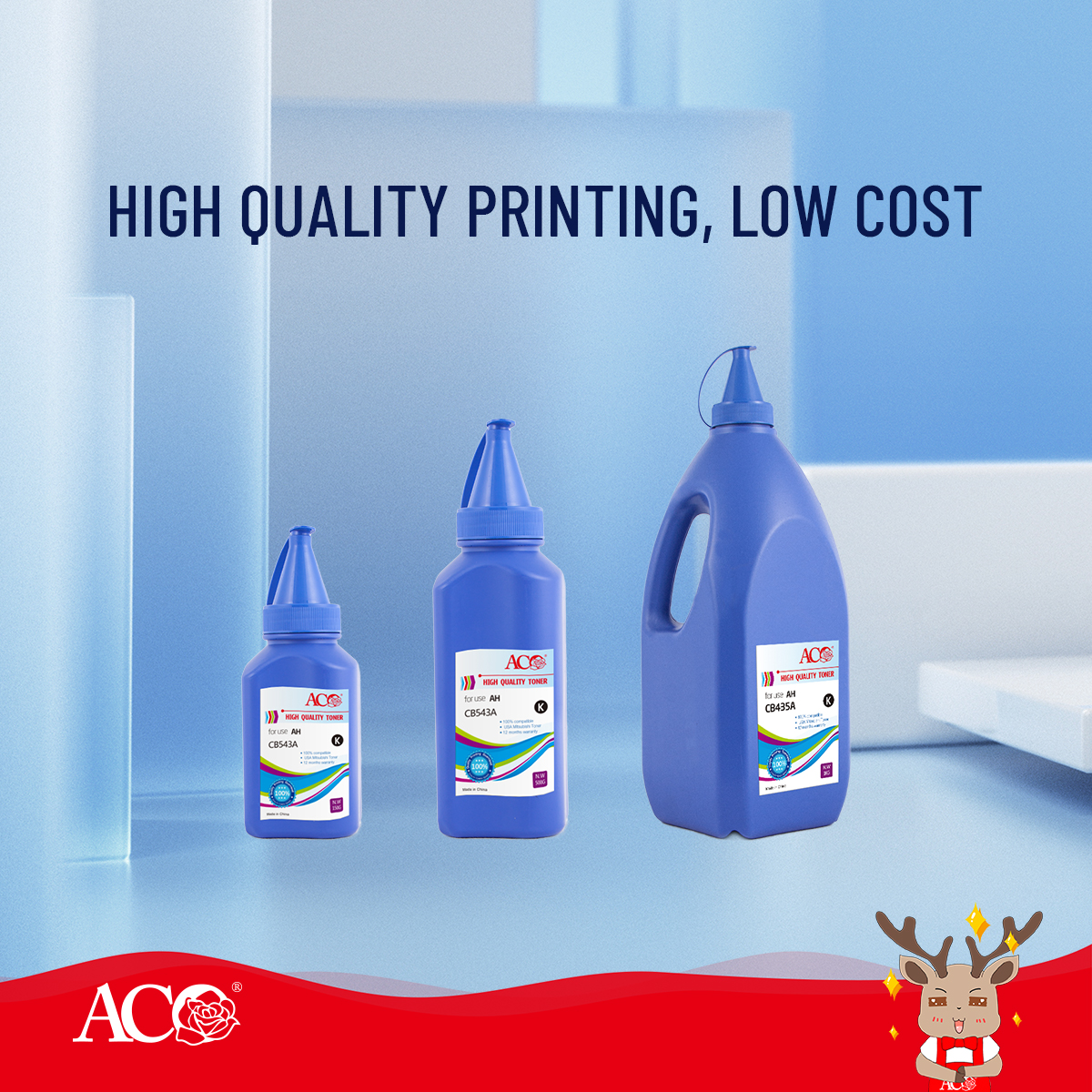
ACO Compatible Toner: Focusing on Every Detail
Toner particle characteristics are a vital determinant of print quality. ACO prioritizes the quality and performance of its compatible toner, providing reliable supplies for overseas wholesalers, distributors, and corporate clients.
From the quality of the toner itself to the final printed result, every detail matters. Choose ACO compatible toner for a superior solution tailored to your daily office printing and commercial needs.